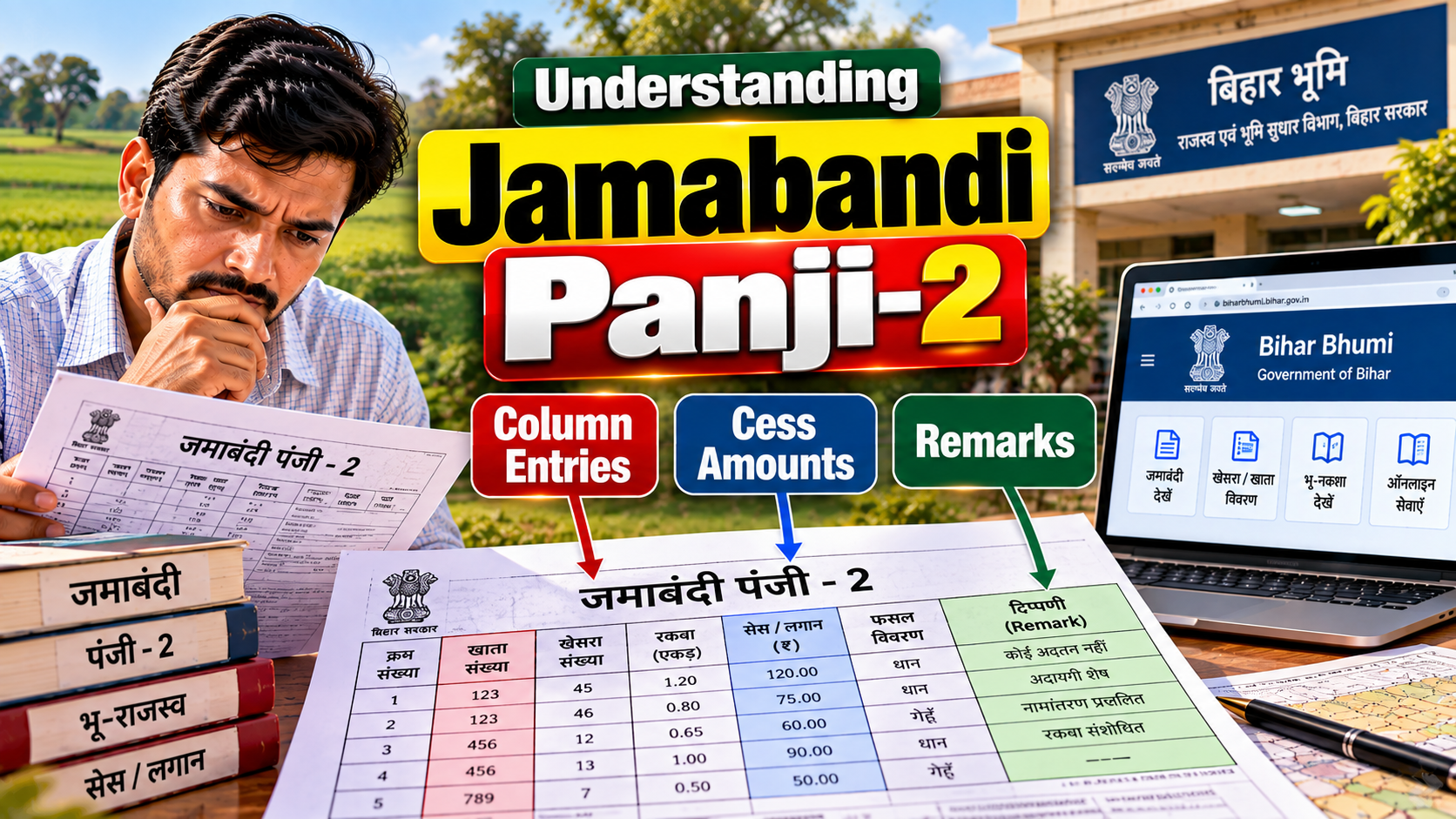
A Jamabandi Panji-2 record can look like a dense grid of numbers and Hindi revenue terms. If you own land in Bihar, or plan to buy or sell it, you will sooner or later need to read one. This guide explains the parts of a Panji-2 entry in plain language, shows how to tell area from money, and explains what cess is and how to treat remarks. It also covers what to do when something looks wrong.
This article is general educational information. It is not legal advice, and it does not replace the advice of a lawyer or the decision of a revenue authority.
Table of Contents
- What Is Jamabandi Panji-2?
- Understanding the Basic Terms in Panji-2
- How to Read the Main Panji-2 Columns
- What Does Cess Mean in Jamabandi Panji-2?
- How to Understand Remarks in a Panji-2 Record
- Example: Reading a Hypothetical Panji-2 Entry
- Common Mistakes When Reading Panji-2
- What to Do If a Panji-2 Entry Looks Incorrect
- Frequently Asked Questions
- Conclusion
What Is Jamabandi Panji-2?
In Bihar, a Jamabandi (जमाबंदी) is a revenue record that lists the raiyat, or landholder, against a particular holding in a village. It ties a person's name to the land they are recorded as holding, along with the rent or revenue (लगान) associated with that holding. The register that holds these entries is often called the Jamabandi register.
Panji-2 (पंजी-2) is the register in which these Jamabandi entries are maintained at the village or mauza level. Bihar land records are commonly discussed in terms of several such registers, and people usually reach Panji-2 when they want to see who is recorded as the raiyat, how much land is recorded, and what revenue is attached to it.
A Panji-2 entry is a revenue record. It is an important document for property-record reading, and revenue authorities use it for administrative purposes such as mutation and rent. That does not mean one entry settles every question of title or possession. Ownership can depend on sale deeds, inheritance, court orders and other documents. Treat Panji-2 as a key piece of evidence to read carefully, not as a final legal verdict.
Bihar has moved its land records online, and the state's land portal, Bihar Bhumi, run under the Bihar Revenue and Land Reforms Department, lets people view Jamabandi details digitally. The exact screens, labels and layout can change over time. Always confirm the current process on the official department portal.
Understanding the Basic Terms in Panji-2
Before reading the columns, get comfortable with the vocabulary. Most confusion comes from mixing up a few similar-sounding numbers.
Jamabandi Number
The Jamabandi number identifies the specific Jamabandi entry within the village's register. Think of it as the entry's serial identity. One raiyat's holding is usually recorded under one Jamabandi number, though one person can hold land under more than one entry. A Jamabandi number is not the same as a khata number, even though people use the words loosely.
Khata Number
The khata (खाता) is an account or holding number. It groups the land held by a raiyat, or by co-holders, in a village. One khata can contain several separate parcels of land. In searches such as khata number Bihar, people are usually trying to locate the whole holding rather than a single plot.
Khesra Number
The khesra (खेसरा) is the plot number. It identifies an individual parcel on the village survey map. A single khata may include many khesra numbers. If you want to know exactly which piece of land a record describes, the khesra number is the detail to check. When you see khesra number Bihar in a listing or deed, it points to a specific plot.
Raiyat or Landholder Name
The raiyat is the person recorded as holding the land, usually with the father's or husband's name beside it to distinguish people with common names. In a tenancy context, you may also see references to a tenant. The name column shows who is recorded, and it is worth reading spelling and relationship details with care.
Location Fields
Most records also show the location hierarchy: district, thana, anchal (also called circle), mauza and village. These fields matter because khata and khesra numbers repeat across villages. A khata number is only meaningful together with the correct village, mauza and anchal.
How to Read the Main Panji-2 Columns
Layouts can differ between older registers, printed copies and online displays, and field names can vary. Not every record shows every field below. Use this as a reading guide, not as a fixed template.
| Field | What it tells you |
|---|---|
| Jamabandi number | Identity of the entry in the register |
| Khata number | The holding or account |
| Khesra number | The individual plot |
| Raiyat name | Person recorded as holder |
| Area | Recorded land size |
| Land classification | Type or use of the land |
| Lagan | Recorded rent or revenue |
| Cess | Separate levy amount, where shown |
| Payment and arrears | Amounts paid and any dues |
| Remarks | Contextual notes on the entry |
Identification Numbers
Start with the Jamabandi, khata and khesra numbers. Confirm they match the village and anchal you expect. If you are cross-checking against a sale deed or a map, these are the values that must line up.
Names
Check the raiyat's name, the relative's name and any co-holders. Small spelling differences are common in older records, but they can cause trouble in a later transaction. Note any difference and compare it with other documents.
Land Area
Area describes size, not value. Bihar records have traditionally used local units such as decimal (dismil), katha and bigha, and areas may also appear in acres or hectares. The unit used depends on the record. Read the unit heading before reading the number, because the same figure means very different things in different units.
Land Classification
Land classification (किस्म) describes the recorded nature or use of the land, such as agricultural land or homestead land. This can affect how the land is dealt with in official processes. If the classification looks different from how the land is actually used, note it and raise it with the revenue office rather than assuming it is a simple typing error.
Lagan or Land Revenue
Lagan (लगान) is the rent or land revenue recorded against the holding. It is a money amount, usually shown per year, and it is separate from area. A small plot can have a small lagan and a large holding a larger one, but the two columns should never be read as the same thing.
Cess, Demand, Payment and Arrears
Where these columns exist, they describe the money side of the record. Cess is discussed in detail in the next section. The demand is the total amount due for a revenue year. Payment shows what has been paid, often with a receipt reference or date. Arrears (बकाया) show anything unpaid from earlier years. Some records show only some of these fields, and online displays may summarise them differently from a printed register.
Revenue Year
Money entries belong to a specific revenue year. Always check which year a payment or arrear refers to. A payment recorded for one year does not clear dues for another.
Remarks
The remarks column carries notes about the entry. It is covered in its own section below.
What Does Cess Mean in Jamabandi Panji-2?
Cess (सेस) is an additional levy charged on top of, and separately from, the basic rent or land revenue. In a Panji-2 record, the cess amount, where it is shown, is a money figure recorded alongside the lagan. It is not the rent itself, and it is not a measure of land.
The simplest way to keep the fields straight is to ask what each number measures:
- Area measures the size of the land, in units such as decimal, katha, bigha, acre or hectare.
- Lagan is the recorded rent or land revenue, a money amount.
- Cess is a separate levy amount, also money, recorded next to the lagan.
- Demand is the total sum due for the year, which may combine lagan, cess and any other applicable components.
- Payment is what has actually been paid.
- Arrears are amounts still outstanding from earlier periods.
Cess is not the same as lagan, and it is not the same as total demand. Reading a cess figure as the whole revenue, or the whole demand as cess, is a common error.
This article deliberately gives no fixed cess rate or formula. How cess is calculated can depend on the governing legal provisions, the category of land, the period concerned and how the record was prepared. Records from different periods may also show cess differently. If you need to know how a specific cess figure was arrived at, ask the Anchal or Circle office, or check the current rules published by the Revenue and Land Reforms Department. Do not rely on a rate quoted by a broker or an unofficial website.
When you read the money columns together, a sensible sequence is: find the revenue year, note the lagan, note the cess, see how the demand is stated, then compare payments and arrears. If the numbers do not appear to add up under the layout you are viewing, do not assume an error. The record may show components you cannot see, or it may follow a different format.
How to Understand Remarks in a Panji-2 Record
The remarks column gives context for an entry. It may point to how the entry came to exist or what has happened to it. Depending on the record, remarks might refer to a mutation (दाखिल-खारिज), a transfer of land, inheritance, a partition of a holding, a correction, or a reference to an order or case.
Read remarks as clues, not conclusions. A remark that mentions a mutation, for instance, tells you that the record refers to a mutation. It does not by itself tell you that the mutation was approved, that it is still valid or that it settled a dispute. In the same way, a note about inheritance or partition does not automatically prove who owns what, and a reference to a correction does not confirm that the correction is complete.
If a remark is unclear, abbreviated or written in an unfamiliar shorthand, do not guess its meaning. Ask the Anchal office, which maintains the underlying records, and where possible request the related order or the linked mutation record. If a remark relates to a land transaction you are considering, discuss it with a qualified lawyer before you commit.
Also note that some entries have no remarks at all. An empty remarks column does not mean the record is clean or problem-free. It simply means nothing was noted there.
Example: Reading a Hypothetical Panji-2 Entry
This is a fictional example created only to show the reading method. The names and numbers are invented and do not come from any real Bihar government record.
Imagine a record with the following details:
- District: Imaginary District
- Anchal: Sample Anchal
- Mauza: Example Mauza, Village: Example Gaon
- Jamabandi number: 101
- Khata number: 25
- Khesra number: 340
- Raiyat: Ramesh Kumar Test, son of Suresh Kumar Test
- Area: 12 decimal
- Land classification: Agricultural
- Lagan: a small annual rupee amount
- Cess: a separate, smaller rupee amount
- Remarks: a note mentioning a mutation
Here is how a careful reader would move through it.
- Confirm the location. The district, anchal, mauza and village must match the land you are checking. Khata 25 in a different village is a different holding.
- Read the identification numbers. Jamabandi 101 is the entry. Khata 25 is the holding. Khesra 340 is the plot within it. If the holding has other plots, they would appear under other khesra numbers.
- Check the name. The raiyat is Ramesh Kumar Test, son of Suresh Kumar Test. Compare this with the name in your deed or other documents.
- Read the area with its unit. The 12 is a measure of land in decimals. It is not money.
- Note the classification. The land is recorded as agricultural. Check that this fits how the land is used and described elsewhere.
- Separate the money figures. The lagan is the rent. The cess is a distinct amount beside it. Neither is the area, and neither is automatically the total demand.
- Look at the revenue year. Identify which year the payment and arrears figures refer to.
- Read the remark carefully. The mention of a mutation tells you a mutation is referred to. To learn whether it was approved and what it changed, you would need the mutation order or a check with the Anchal office.
Working through the fields in this order, identification, name, area, money, then remarks, keeps you from mixing up numbers that look similar.
Common Mistakes When Reading Panji-2
- Confusing khata and khesra numbers. The khata is the holding and the khesra is the plot. Quoting the wrong one in a deed or application creates avoidable problems.
- Reading area as a monetary amount. A figure like 12 in the area column is a land measure. Check the unit before the number.
- Assuming cess is the same as total land revenue. Cess is a separate levy recorded next to lagan, and total demand may combine several components.
- Treating a remark as a complete legal conclusion. A remark is context. It does not prove ownership, possession or the outcome of a mutation on its own.
- Ignoring the revenue year. Payments, demand and arrears belong to particular years. Mixing years leads to wrong conclusions about dues.
- Assuming an online display resolves every record issue. A Bihar online Jamabandi view is a display of the digital record. Errors in the underlying record, or gaps between the digital and older paper records, can still exist.
- Relying on an old copy. Records can be updated after mutation or correction. An old printout may not show the latest position.
What to Do If a Panji-2 Entry Looks Incorrect
If a name, area, classification or amount looks wrong, stay calm and work methodically. Errors in old records are not unusual, and there is a process for raising them.
- Re-check what you are reading. Confirm the village, mauza, khata and khesra. Many apparent errors come from looking at the wrong holding or the wrong year.
- Compare with other records. Look at your sale deed, inheritance papers, earlier rent receipts, the survey map and any mutation order. Note exactly what differs and where.
- Check the current record. View the latest version on the official Bihar Bhumi portal, since the entry may already have been updated.
- Contact the Anchal or Circle office. The Circle office, headed by the Circle Officer, maintains land records at the local level. Ask what is required to correct the entry and whether a mutation or correction application is the right route for your situation.
- Gather your documents. Keep copies of identity proof, title or inheritance documents, receipts and a clear written note of the discrepancy.
- Keep a record of what you submit. Note application dates and reference numbers so you can follow up.
- Seek professional help for disputes. If ownership is contested, if a co-holder disagrees, or if a large transaction depends on the record, speak to a qualified lawyer. If the matter goes beyond the local office, the district administration and the Revenue and Land Reforms Department are the wider channels.
Procedures, forms and timelines can change. Confirm the current steps with the local office or the official department portal rather than relying on second-hand descriptions.
Frequently Asked Questions
What is Panji-2 in Bihar?
Panji-2 is the register in which Jamabandi entries are maintained for a village or mauza in Bihar. Each entry links a raiyat, or landholder, to a holding and records details such as area and the associated rent.
What is a Jamabandi number?
A Jamabandi number identifies a specific Jamabandi entry within a village's register. It is not the same as a khata number or a khesra number, although all three appear together in most records.
What is the difference between khata and khesra?
The khata is the account or holding, which can contain several parcels of land. The khesra is the number of one individual plot. One khata can include many khesra numbers.
What does cess mean in Panji-2?
Cess is a separate levy recorded alongside the basic rent or land revenue. Where a record shows it, it appears as a money amount distinct from area and from lagan. How it is calculated depends on the applicable rules, so ask the Anchal office if you need the basis for a specific figure.
Is cess the same as lagan?
No. Lagan is the recorded rent or land revenue. Cess is an additional levy shown separately. Total demand may combine these and other components, depending on the record.
What do remarks mean in a Jamabandi record?
Remarks give context about an entry, such as a reference to mutation, transfer, inheritance, partition or correction. They are clues, not legal conclusions. If a remark is unclear, ask the revenue office and request the related order.
Can a Panji-2 entry contain old information?
Yes. An entry may reflect an earlier position if updates were not made or were made later. Compare the entry with recent documents and check the current version on the official portal.
What should I do if the name or area is incorrect?
Verify that you are reading the correct holding, compare the entry with your own documents, and contact the Anchal or Circle office about the correction process. Keep copies of everything you submit. For a contested matter, consult a lawyer.
Does a Jamabandi entry by itself settle every ownership issue?
No. A Jamabandi entry is an important revenue record, but ownership, title and possession can depend on other documents and, in some cases, on court decisions. Read the entry together with deeds, mutation records and other papers.
Conclusion
Reading a Jamabandi Panji-2 record gets easier once you follow a fixed order. Confirm the location first, then the Jamabandi, khata and khesra numbers, then the name. Read area as land size, lagan as rent, and cess as a separate levy. Check the revenue year before drawing any conclusion from payments or arrears, and treat remarks as context rather than proof.
Above all, avoid reading one entry as the last word on ownership. Compare it with your other documents, check the current version on the official Bihar Bhumi portal, and go to the Anchal or Circle office when something does not look right. For any high-value transaction or dispute, take advice from a qualified professional.