Table of Contents
- What Does Dakhil Kharij Rejection Mean in Bihar?
- Why Is Dakhil Kharij Rejected in Bihar?
- When Should You File a DCLR Appeal?
- Documents to Keep Ready for a DCLR Appeal
- How to File a DCLR Appeal Online in Bihar
- How to Check Your DCLR Appeal Status
- What If the Problem Is an Incorrect Jamabandi?
- Common Mistakes to Avoid
- Practical Example
- Frequently Asked Questions
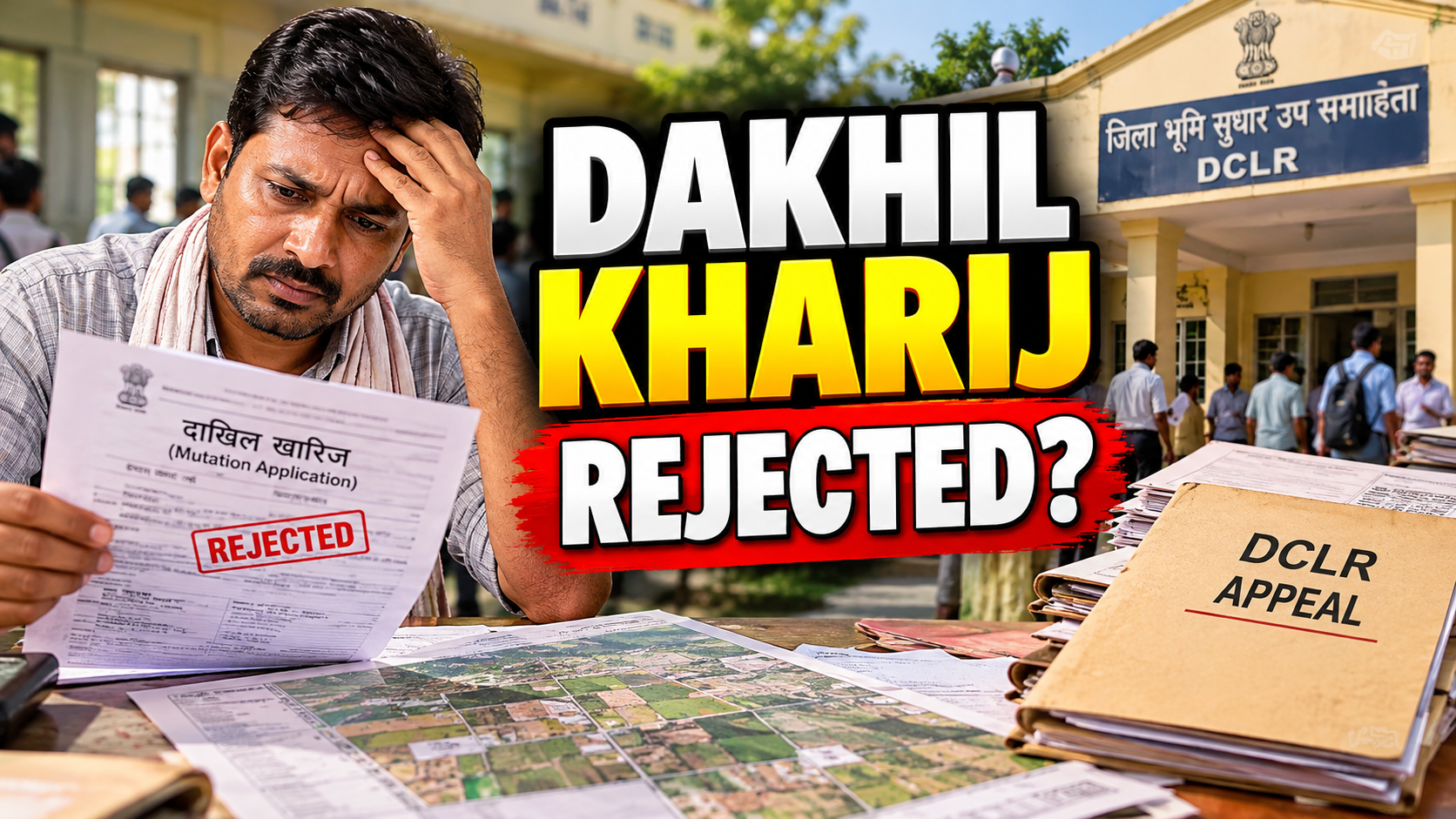
If your Dakhil Kharij rejected in Bihar notice has just landed in your hands, the first thing to know is that you are not stuck. Bihar's revenue rules give you a clear route out of this situation: a DCLR appeal. This article walks you through why mutation applications get turned down, how the appeal process works, and what to keep ready before you file.
What Does Dakhil Kharij Rejection Mean in Bihar?
Dakhil Kharij, also called नामांतरण or mutation, is the process of updating land ownership records after a sale, inheritance, partition, gift, or court order. The Circle Officer (अंचल अधिकारी) at the concerned Anchal (circle) reviews the application and either approves it, updating Register-II and the Jamabandi record, or rejects it.
A rejection simply means the Circle Officer was not satisfied that the application, as submitted, met the requirements for updating the record. It does not mean your underlying right to the property has been decided one way or the other. It's also worth remembering that mutation records are maintained for revenue and administrative purposes; they support your claim over land but do not, by themselves, conclusively establish ownership or title in a legal dispute. If there is a genuine title dispute, that is a separate matter from a Dakhil Kharij rejection and may need proper civil legal advice.
Why Is Dakhil Kharij Rejected in Bihar?
The Bihar Revenue and Land Reforms Department has pointed to several recurring, documented reasons behind mutation rejection Bihar cases. Common ones include:
- Missing or incomplete documents attached with the application
- A mismatch between the supporting documents (such as the sale deed) and the details entered in the online application
- Mathematical or clerical discrepancies, for instance in area or survey figures
- Problems with Khata, Khesra, or Rakba details not matching land records
- Errors in the online Jamabandi itself, including missing Khata/Khesra information
- Selection of an incorrect Jamabandi while filing the application
Beyond these commonly cited reasons, your own case may have been rejected for a reason specific to your application. Rather than guessing, always read the actual rejection order carefully. It typically states the ground for rejection, and that ground should guide what you do next, whether that's an appeal or a correction request.
| Rejection Reason | What to Check or Do Next |
|---|---|
| Missing/incomplete documents | Compare submitted documents against portal requirements; gather missing papers |
| Document–application mismatch | Re-check names, area, and khata/khesra entered versus the sale deed or other title document |
| Clerical or numerical error | Recheck figures entered in the application against original records |
| Wrong or unavailable Jamabandi | Verify the correct Jamabandi number before proceeding; correction via Parimarjan may be needed |
| Reason unclear from order | Read the order text carefully or seek clarification before deciding next steps |
When Should You File a DCLR Appeal?
If you believe the Circle Officer's mutation order was wrong, unjustified, or based on an error, Bihar's mutation rules give you the right to appeal. Under Rule 11 of the Bihar Land Mutation (Amendment) Rules, 2017, a person aggrieved by an order passed by the Circle Officer may appeal to the concerned Land Reforms Deputy Collector, commonly called the DCLR (भूमि सुधार उप समाहर्ता), within 30 days from the date of the order.
This 30-day limitation period is not a suggestion; it is the legal window within which the appeal case, sometimes referred to as a Dakhil Kharij appeal case, must ordinarily be filed before the DCLR court. Do not wait to "sort out documents first" and delay filing. If your documentation is incomplete, start collecting it immediately, but do not let the 30-day period lapse while you do that. Once this window closes, pursuing your grievance may become more complicated, so treat the date on your rejection order as your countdown starting point.
Documents to Keep Ready for a DCLR Appeal
Exactly which documents you need depends on your specific case and the reason for rejection, so always confirm requirements against the official Bihar Bhumi and Revenue Court Management System (RCMS) portal at the time of filing. That said, applicants preparing a DCLR appeal Bihar case commonly keep the following ready:
- A copy of the rejection order passed by the Circle Officer, along with the case/application number
- Details of the original mutation application as submitted
- The sale deed or other document that forms the basis of the mutation claim
- Succession-related documents, where the mutation is based on inheritance
- Partition documents, where relevant
- A will, where the claim arises from a testamentary document
- A relevant court order, if one exists and applies to the case
- Jamabandi or Register-II extracts relevant to the land in question
- Identification and contact details as required by the portal
- Any other evidence that directly supports your grounds of appeal
Not every document listed above is mandatory in every case. Some apply only where relevant, for instance a will is only needed if inheritance through a will is part of your claim. Treat the actual portal fields and your case facts as the final word on what is required.
How to File a DCLR Appeal Online in Bihar
Bihar Bhumi's Revenue Court Management System allows revenue cases, including mutation appeals, to be filed and tracked online. While exact button labels and screen layouts can change with portal updates, the broad workflow for a DCLR appeal online Bihar filing generally follows this pattern:
- Go to the official Bihar Bhumi website.
- Navigate to the Revenue Court Management System section on the portal.
- Look for the online case-filing or new-case option within RCMS.
- Log in or register on the portal if the system requires it for filing a case.
- Select the appropriate revenue court or authority, in this instance the DCLR court relevant to your area.
- Choose the applicable case or appeal category, and the relevant Act, where the portal asks you to specify this.
- Select your district and the concerned circle (अंचल).
- Enter the land details relevant to your case, such as Khata, Khesra, and mouza information.
- Enter the details of the original Circle Officer order and application accurately, since mismatches here can cause processing delays.
- Upload the supporting documents and evidence relevant to your appeal.
- Review every field carefully before submission, particularly names, dates, and case numbers.
- Submit the case through the portal.
- Save the acknowledgement receipt and case number generated after submission; you will need this to track your appeal later.
Because government portals are updated periodically, treat this as a general explanation of the workflow. If any screen on the actual Bihar Bhumi or RCMS portal looks different from what is described here, follow the current on-screen instructions rather than this outline.
How to Check Your DCLR Appeal Status
Once your Dakhil Kharij appeal case is filed, the Bihar Bhumi Revenue Court Management System provides a facility to check case status and view orders or judgments passed by the DCLR court. You will typically need your case number or related application details to look up the current stage of your appeal.
There is no verified fixed processing timeline that applies uniformly to every case, since this can depend on the DCLR court's caseload, the nature of the dispute, and case-specific facts. Rather than assuming a fixed number of days, check your Dakhil Kharij status Bihar periodically through the official portal, and note any hearing dates or orders that are uploaded against your case.
What If the Problem Is an Incorrect Jamabandi?
Sometimes the root cause of a rejection is not the mutation application itself but an underlying problem with the Jamabandi record, for example missing Khata or Khesra entries, or incorrect raiyat details. In such situations, simply refiling the same mutation application without addressing the record-level issue may lead to the same outcome.
The Bihar Bhumi portal advises applicants to verify the seller's or previous raiyat's Jamabandi and related land details before applying for mutation, and points to Parimarjan as the route for correcting errors in the Jamabandi record itself. It is useful to separate these two remedies clearly in your mind: a DCLR appeal challenges the Circle Officer's rejection order, while a Parimarjan-based correction addresses a defect in the underlying land record. Depending on the exact issue behind your rejection, you may need one, the other, or in some cases both, so it helps to identify precisely which type of problem your rejection order describes before choosing your next step.
Common Mistakes to Avoid
- Missing the 30-day window to file a DCLR appeal after the rejection order
- Ignoring the exact reason stated in the rejection order and guessing instead
- Uploading unclear, incomplete, or poor-quality scanned documents
- Entering incorrect Khata, Khesra, or Rakba figures in the appeal case
- Selecting the wrong Jamabandi while filing, repeating the original error
- Submitting inconsistent information across different fields of the case
- Failing to save or note down the case number and acknowledgement details
- Assuming that mutation, once granted, automatically settles a title dispute
- Relying on unofficial websites or unverified sources for procedural or legal information instead of the official Bihar Bhumi and RCMS portals
Practical Example
Here is a hypothetical, illustrative scenario, not a real case, that shows how these steps might apply in practice. Suppose a person purchases a plot of land through a registered sale deed and applies for Dakhil Kharij online. The application is rejected because the area mentioned in the sale deed does not match the area recorded against that Khata/Khesra in the online Jamabandi.
In this situation, the purchaser would first read the rejection order carefully to confirm this is indeed the stated reason. Next, they would compare the sale deed figures with the Jamabandi entry to understand where the discrepancy lies. If the discrepancy stems from an error in the Jamabandi record itself, correcting that record through the appropriate mechanism may be a necessary step alongside, or before, pursuing an appeal. If, instead, the purchaser believes the Circle Officer's rejection was not justified given the facts on record, they would prepare their supporting documents, including the sale deed, the rejection order copy, and relevant Jamabandi extracts, and file a DCLR appeal within the 30-day period, clearly explaining the discrepancy and their grounds for appeal.
Frequently Asked Questions
How many days do I have to file a DCLR appeal in Bihar?
Under Rule 11 of the Bihar Land Mutation (Amendment) Rules, 2017, you generally have 30 days from the date of the Circle Officer's order to file an appeal before the concerned DCLR.
Where can I appeal a rejected Dakhil Kharij order?
The appeal against a Circle Officer's mutation order is filed before the concerned Land Reforms Deputy Collector (DCLR) having jurisdiction over your circle.
Can I file a DCLR appeal online?
Yes, the Bihar Bhumi portal's Revenue Court Management System allows revenue cases, including DCLR appeals, to be filed online. Follow the current steps on the official portal since interface details can change.
What documents may be needed for the appeal?
This depends on your case, but commonly relevant documents include the rejection order, the original application details, the sale deed or other title document, and any succession, partition, will, or court-order papers applicable to your claim.
What if my Jamabandi contains an error?
If the underlying Jamabandi record itself has an error, such as incorrect Khata or Khesra details, correction through Parimarjan may be the appropriate remedy, separate from filing a DCLR appeal against a rejection order.
How can I check my DCLR appeal status?
You can check case status and view orders or judgments through the Revenue Court Management System on the official Bihar Bhumi portal using your case number.
What happens after filing a DCLR appeal?
The DCLR court examines the appeal against the Circle Officer's order, and the matter proceeds through the revenue court process. Outcomes and timelines vary by case, so there is no fixed guaranteed result or duration.
Can I file a fresh mutation application instead of appealing?
This depends on why your earlier application was rejected. If the issue lies in the underlying record, such as an incorrect Jamabandi, a fresh application without correcting that issue may face the same rejection. Consider whether an appeal, a record correction, or both are appropriate for your situation.
Does mutation prove ownership of land?
No. Mutation updates revenue records for administrative purposes and supports your claim, but it does not by itself conclusively establish legal ownership or title. Genuine title disputes may require separate civil or legal remedies.
Conclusion
Dealing with a rejected Dakhil Kharij application in Bihar comes down to a simple, practical sequence. Start by reading the rejection order carefully to understand the exact reason. Collect the supporting evidence relevant to your case. Keep a close eye on the 30-day appeal deadline under Rule 11 and do not let it pass. File your appeal before the appropriate DCLR, whether online through the Revenue Court Management System or as per current portal procedures. Preserve your case number and acknowledgement details carefully. Finally, monitor your case status and any orders through the official Bihar Bhumi portal. Filing a DCLR appeal gives you a proper legal route to challenge the Circle Officer's order, though it does not guarantee any particular outcome, and case-specific issues may still call for professional legal advice.