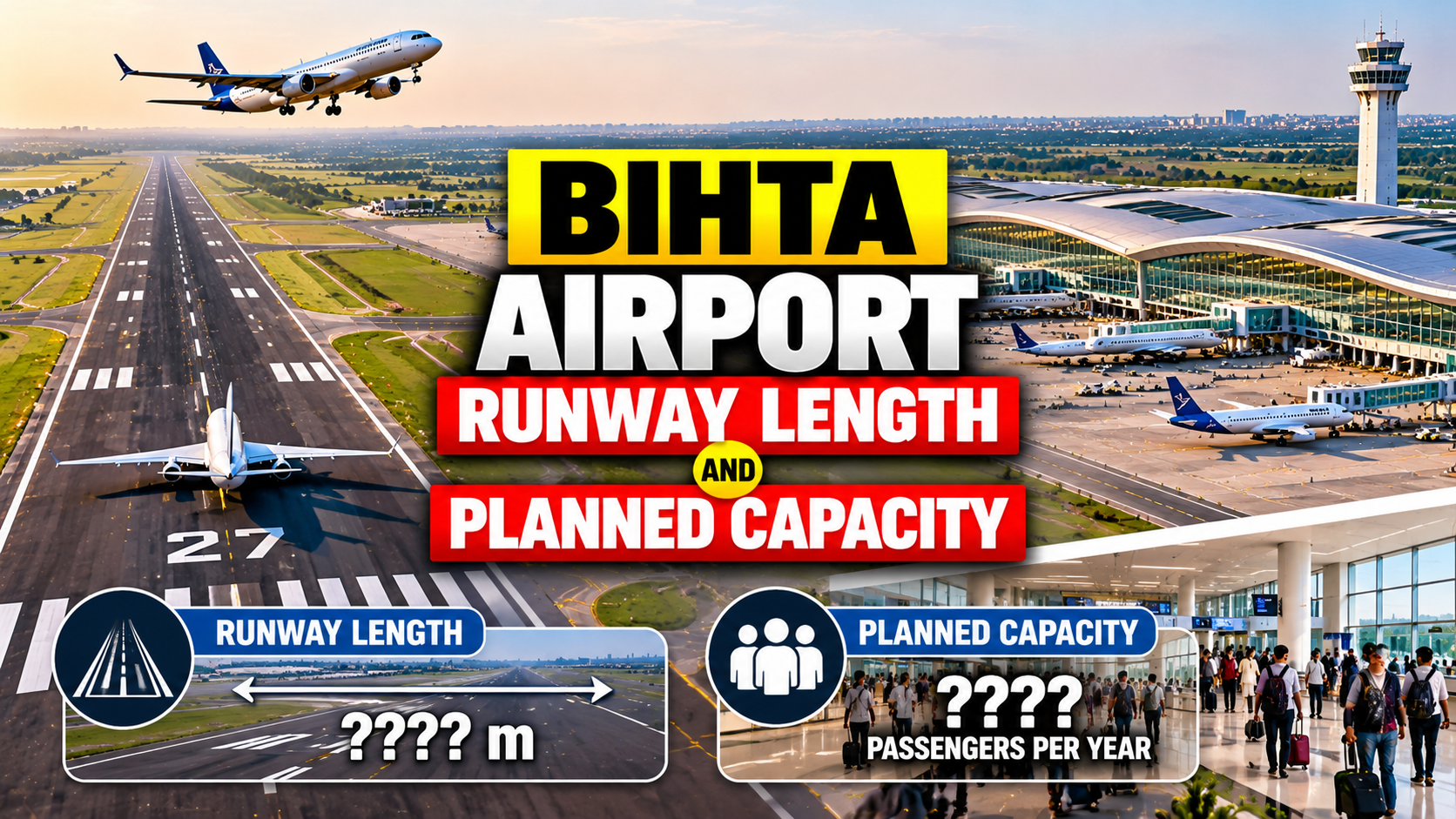
Bihta Airport’s existing runway is about 8,200 feet long, or approximately 2,499 metres. Official parliamentary records state that this existing runway can handle A-320 and A-321 type aircraft without load penalty. A proposal has also been discussed to extend the runway to 12,000 feet, or about 3,658 metres, to support wide-body aircraft and possible international operations in the future.
The new civil enclave at Bihta is planned with a 66,000 square metre integrated terminal, a design capacity of 3,000 peak-hour passengers, and an initial annual capacity of 50 lakh passengers. The government has also stated that the facility can be expanded to handle 1 crore passengers annually in the future.
Last updated: 13 October 2026. This article separates the existing runway, proposed extension, approved civil-enclave scope and future capacity plans. It does not treat a proposal as a completed project.
Quick Facts
| Item | Verified information | Status |
|---|---|---|
| Existing runway length | 8,200 feet, approximately 2,499 metres | Existing airbase specification |
| Proposed runway length | 12,000 feet, approximately 3,658 metres | Proposed extension; land handover was earlier pending |
| Terminal area | 66,000 square metres | Approved civil-enclave scope |
| Peak-hour passenger capacity | 3,000 passengers | Planned design capacity |
| Initial annual passenger capacity | 50 lakh passengers | Planned capacity |
| Future annual passenger capacity | 1 crore passengers | Planned expansion capacity |
| Aircraft parking | 10 parking bays | Approved civil-enclave scope |
| Taxiways | Two link taxiways | Approved civil-enclave scope |
What Is the Existing Runway Length of Bihta Airport?
The existing runway at Bihta Airport is 8,200 feet long. In metres, this is approximately 2,499 metres. This figure refers to the existing runway at the Bihta airbase, which is used by the Indian Air Force.
According to a parliamentary committee report, the existing 8,200-foot runway can cater to A-320 and A-321 type aircraft without load penalty. This means aircraft of these types can operate using their normal payload capacity, rather than carrying less fuel, cargo or passengers because of runway limitations.
Readers should remember that the 8,200-foot figure describes the existing airbase runway. It should not be confused with the new terminal, apron and passenger facilities being developed as part of the Bihta civil enclave.
Is Bihta Airport’s Runway Planned to Be Extended?
Yes. An extension of the Bihta runway to 12,000 feet has been discussed in official government records. In metres, 12,000 feet is approximately 3,658 metres.
The purpose of the proposed extension is to make the airport suitable for wide-body aircraft such as the Boeing 777 and Boeing 787. Official records also link this longer runway with the possibility of international operations and cargo growth.
However, this is a proposed extension, not a completed runway. A parliamentary committee report noted that the Airports Authority of India had sought additional land for the extension. The report stated that 191.5 acres were sought for extending the runway to 12,000 feet and installing approach lights, while eight acres were sought for shifting the terminal location to accommodate a Code E aircraft parking stand.
The same report recorded that the required land had not yet been handed over to the Airports Authority of India at that time. Therefore, readers should not describe the 12,000-foot runway as existing, approved for construction, under construction or completed unless a newer official announcement confirms that status.
Existing runway vs proposed runway
| Runway detail | Length in feet | Length in metres | Status |
|---|---|---|---|
| Existing Bihta runway | 8,200 feet | About 2,499 metres | Existing airbase runway |
| Proposed Bihta runway | 12,000 feet | About 3,658 metres | Proposed extension |
| Additional length under proposal | 3,800 feet | About 1,158 metres | Dependent on land and approvals |
What Is the Planned Passenger Capacity of Bihta Airport?
The approved Bihta civil-enclave project includes an integrated terminal designed for 3,000 peak-hour passengers. This is often written as 3,000 PHP. PHP means the number of passengers the terminal is designed to handle during its busiest hour.
The initial annual passenger capacity is 50 lakh passengers. In international aviation terms, this is 5 million passengers per annum, or 5 MPPA. The government has also stated that the terminal can be expanded by another 50 lakh passengers, taking the future capacity to 1 crore passengers annually, or 10 MPPA.
These are planned capacity figures, not actual passenger numbers. Since Bihta Airport has not been confirmed as operational for scheduled commercial passenger flights, no actual annual passenger traffic figure should be attributed to it.
Understanding the capacity terms
- Peak-hour passengers: The number of passengers a terminal can process in its busiest hour.
- Annual passenger capacity: The total number of passengers the terminal is designed to handle in one year.
- Expansion capacity: Additional passenger-handling capacity that may be developed in a future phase, subject to plans and approvals.
- MPPA: Million passengers per annum. One MPPA equals 10 lakh passengers annually.
Bihta Airport Terminal Size and Facilities
The approved project includes a new integrated terminal building covering approximately 66,000 square metres. It is planned as a modern passenger terminal for the Bihta civil enclave.
The terminal is designed to handle 3,000 peak-hour passengers and 50 lakh passengers annually in the initial stage. The government has stated that capacity can be expanded to 1 crore passengers annually in the future.
The terminal project also includes passenger-related facilities such as check-in areas, security hold areas, baggage-claim arrangements, retail and food-and-beverage spaces, airline offices and support areas. These details come from the civil-enclave project scope and should not be confused with a final as-built layout.
How Many Aircraft Can Park at Bihta Airport?
The approved Bihta civil-enclave project includes an apron with 10 aircraft parking bays. The project announcement says these bays are suitable for A-321, B-737-800 and A-320 type aircraft.
The project also includes two link taxiways. Taxiways are paved paths that connect the runway to the apron and terminal area. They allow aircraft to move between the runway and parking stands.
Aircraft parking capacity and passenger capacity are different measures. Ten parking bays do not mean that the airport will handle only ten aircraft in a day. Aircraft can arrive, park, unload, load and depart at different times. Similarly, the 3,000 peak-hour passenger capacity relates to the terminal, not the number of aircraft stands.
Can Bihta Airport Handle Wide-Body Aircraft?
In the future, Bihta Airport may be able to handle wide-body aircraft if the proposed runway extension and related works are completed. Official records specifically mention the Boeing 777 and Boeing 787 in the context of a 12,000-foot runway extension.
However, the existing 8,200-foot runway is described as suitable for A-320 and A-321 type aircraft without load penalty. It should not be assumed that wide-body aircraft can operate there today merely because the extension has been discussed.
Runway length is important, but it is not the only requirement for wide-body operations. An airport also needs suitable pavement strength, runway width and declared distances, taxiways, apron stands, rescue and firefighting arrangements, navigation aids, regulatory approvals and airline operational plans.
Therefore, the correct position is:
- Existing capability: The 8,200-foot runway is officially described as suitable for A-320/A-321 type aircraft without load penalty.
- Future capability: A 12,000-foot runway has been proposed to support wide-body aircraft such as B-777 and B-787.
- Current wide-body operations: Not confirmed.
- International long-haul services: Not confirmed.
How Will Bihta Airport Support Patna’s Aviation Needs?
Bihta is being developed as an additional civil aviation facility for the Patna region. It is not a replacement for Jay Prakash Narayan International Airport in Patna.
Official records explain that Patna Airport faces land constraints. Its runway extension is restricted by a railway track on one side and a zoo on the other. This limits the ability to expand the existing Patna airport infrastructure further.
Bihta has more scope for development. The new civil enclave is intended to add terminal capacity, aircraft parking and airside infrastructure for the growing aviation needs of Patna and nearby districts.
If completed and operational, Bihta can help reduce pressure on Patna Airport and support better air connectivity for Bihar. However, specific flight routes, airline operations, passenger growth and economic benefits will depend on future demand, airline decisions and official operational approvals.
Current Construction and Development Status
The Bihta civil enclave was approved by the Cabinet Committee on Economic Affairs in August 2024 at an estimated cost of ₹1,413 crore. The approved scope includes the integrated terminal, apron, taxiways and related passenger infrastructure.
The project is in the development stage. A construction announcement or tender process should not be treated as proof that the airport has started passenger operations.
For the latest construction progress, readers should check official updates from the Airports Authority of India and the Ministry of Civil Aviation. The runway extension remains a separate future requirement and should not be assumed to be part of the completed civil-enclave works.
Frequently Asked Questions About Bihta Airport Runway and Capacity
What is the existing runway length of Bihta Airport?
The existing runway length is 8,200 feet, approximately 2,499 metres. This figure relates to the existing Bihta airbase runway.
Is Bihta Airport’s runway being extended to 12,000 feet?
A 12,000-foot runway extension has been proposed in official records to support wide-body aircraft and possible international operations. It should not be treated as completed unless a newer official announcement confirms construction or completion.
What is the planned passenger capacity of Bihta Airport?
The planned initial capacity is 50 lakh passengers annually and 3,000 peak-hour passengers. The terminal can be expanded to 1 crore passengers annually in the future.
How large is the Bihta Airport terminal?
The approved integrated terminal is planned to cover approximately 66,000 square metres.
How many aircraft parking bays are planned at Bihta Airport?
The approved project includes an apron with 10 aircraft parking bays and two link taxiways.
Which aircraft can use the existing Bihta runway?
Official parliamentary records state that the existing 8,200-foot runway can cater to A-320 and A-321 type aircraft without load penalty.
Can Bihta Airport handle Boeing 777 or Boeing 787 aircraft?
These aircraft have been mentioned in official records in connection with the proposed 12,000-foot runway extension. Their actual operation will depend on completion of the extension and other technical and regulatory requirements.
Is Bihta Airport operational for passenger flights?
No official confirmation was found that Bihta Airport has started scheduled commercial passenger flights. The civil enclave is a development project.
Final Summary
Bihta Airport’s existing runway is 8,200 feet long, or about 2,499 metres. It is officially described as capable of handling A-320 and A-321 type aircraft without load penalty.
A proposal to extend the runway to 12,000 feet, or about 3,658 metres, has been discussed to support wide-body aircraft such as the Boeing 777 and Boeing 787. This remains a proposed extension, dependent on land, approvals and execution.
The approved civil enclave includes a 66,000 square metre terminal, 3,000 peak-hour passenger capacity, 50 lakh initial annual passenger capacity, potential expansion to 1 crore passengers annually, 10 aircraft parking bays and two link taxiways. These are planned figures, not current passenger-traffic records.
Deliverable 3: Research and Fact-Check Report
Verified facts
- Existing runway length: 8,200 feet, approximately 2,499 metres — existing airbase specification.
- Aircraft capability of existing runway: A-320 and A-321 type aircraft without load penalty — official parliamentary record.
- Proposed runway length: 12,000 feet, approximately 3,658 metres — proposed extension.
- Purpose of proposed extension: Wide-body aircraft such as B-777 and B-787, international operations and cargo growth.
- Land requirement for extension: 191.5 acres for runway extension and approach lights; eight acres for terminal relocation to accommodate a Code E parking stand.
- Terminal area: 66,000 square metres — approved civil-enclave scope.
- Peak-hour capacity: 3,000 passengers — planned design capacity.
- Initial annual capacity: 50 lakh passengers — planned capacity.
- Future annual capacity: 1 crore passengers — planned expansion capacity.
- Aircraft parking: 10 bays suitable for A-321, B-737-800 and A-320 type aircraft — approved scope.
- Taxiways: Two link taxiways — approved scope.
Unverified or uncertain points
- Whether the 12,000-foot runway extension has since been approved for execution, tendered, started or completed.
- Whether the additional land sought for the extension has been handed over after the date of the parliamentary report.
- Current construction-progress percentage and completion date.
- Actual passenger traffic, since the civil enclave has not been confirmed as operational.
- Actual wide-body aircraft operations at Bihta.
Conflicts and clarification
- Some older material referred to an 8,500-foot runway at Bihta, while a later parliamentary record states 8,200 feet. This article uses the more specific parliamentary figure of 8,200 feet as the existing runway length.
- The 12,000-foot figure is sometimes presented online as if it is the current runway length. Official records describe it as a proposed extension, not an existing runway.
- The 50 lakh annual capacity is a planned capacity figure, not actual passenger traffic.