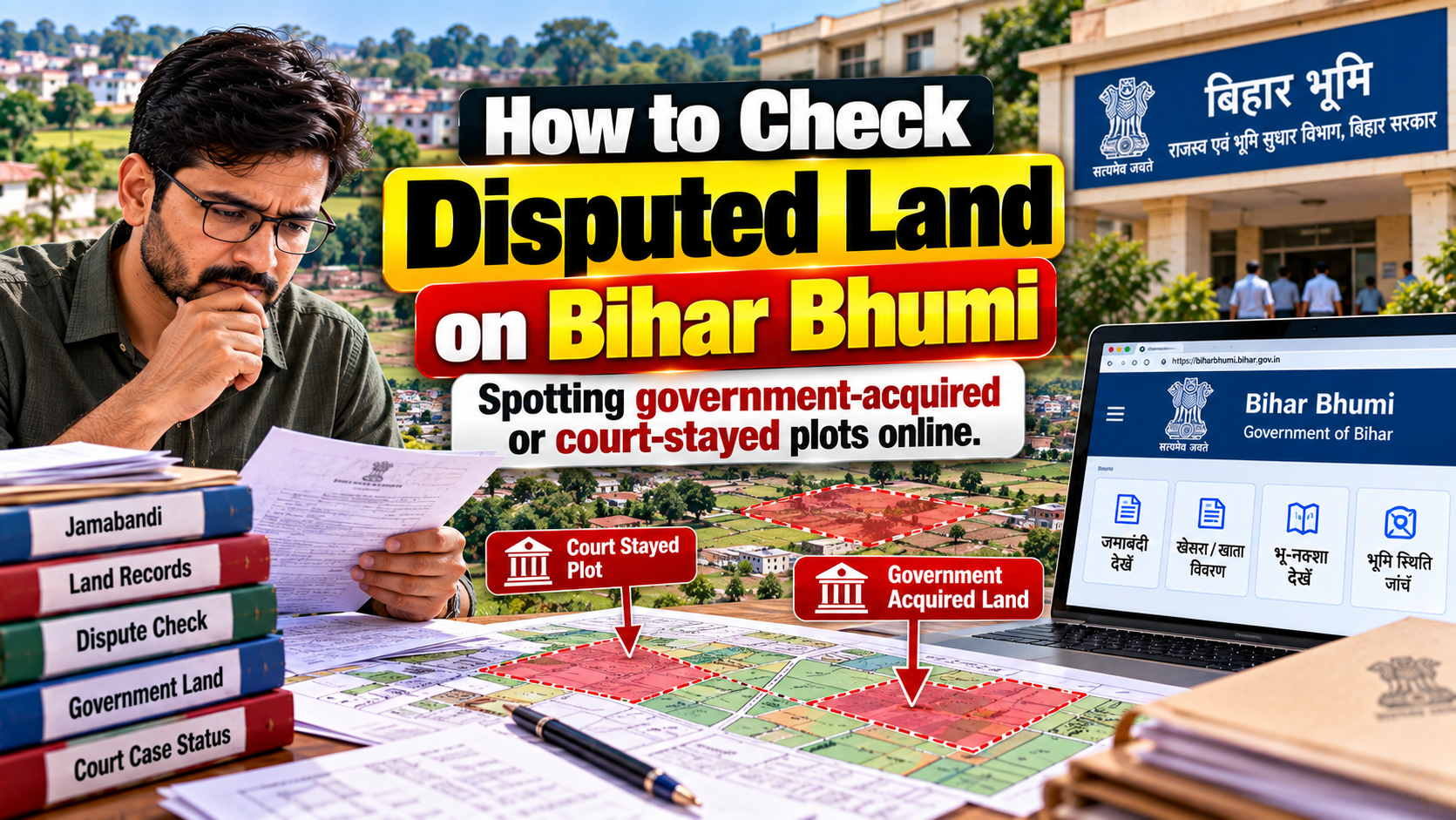
A Bihar Bhumi disputed land check is often the first step buyers take before paying an advance on a plot. It is a sensible step, but it is only one step. The portal shows revenue records, not a complete legal history. A plot can look clean on a Jamabandi extract and still face an acquisition proceeding, a court order or a family claim.
This guide explains what you can verify online, what you cannot, and which other records to check. It uses simple language, because many buyers meet terms like khata, khesra and mutation for the first time when a deal is already on the table.
Table of Contents
- What Counts as Disputed Land in Bihar?
- What Can You Check on Bihar Bhumi?
- Information You Need Before Searching
- How to Check Land Records on Bihar Bhumi
- How to Read Khata, Khesra and Jamabandi Information
- How to Spot Possible Government-Acquired Land
- How to Check Whether a Plot Has a Court Stay or Case
- Other Records to Cross-Check Before Buying Land
- Red Flags That Need Further Verification
- Common Mistakes
- FAQs
- Conclusion
What Counts as Disputed Land in Bihar?
"Disputed" is a broad word. Not every problem is a court case, so it helps to separate the common categories.
- Ownership or title disputes: two or more people claim the same land, or the seller's right to sell is questioned.
- Inheritance and partition disputes: co-heirs disagree about shares in ancestral land, or a partition was never formally recorded.
- Mutation objections: someone objects to the change of name in revenue records (दाखिल-खारिज) after a sale or inheritance.
- Boundary disputes: neighbours disagree about where a plot begins and ends.
- Revenue disputes: proceedings before revenue authorities about records, classification or rent.
- Acquisition-related issues: the land is affected by a government acquisition proceeding for a road, canal or other project.
- Court litigation: a civil or revenue court is hearing a case about the land.
A clerical spelling error in a name is a discrepancy, not necessarily a dispute. Treat each finding on its own facts.
What Can You Check on Bihar Bhumi?
Bihar Bhumi is the state's land-records portal run under the Revenue and Land Reforms Department. Its official site is biharbhumi.bihar.gov.in. Depending on the services active at the time, you can typically look up Jamabandi details, view land particulars for a khata or plot, and follow the status of a mutation application.
Service names and menus change from time to time, so use the labels currently shown on the portal rather than relying on an old screenshot or video.
Can Bihar Bhumi prove clear title? No. It shows what the revenue records say about a parcel. It does not certify that the seller has a marketable title, that no court case exists, or that no acquisition is under way.
| Question | Where to look |
|---|---|
| Who is recorded as raiyat? | Bihar Bhumi (Jamabandi) |
| Is a mutation pending? | Bihar Bhumi and the Anchal office |
| Was the sale deed registered? | Registration records |
| Is the land under acquisition? | Acquisition and Gazette records |
| Is there a case or stay? | Court records |
| Who is in possession? | Site visit and local inquiry |
Information You Need Before Searching
Land records in Bihar are organised by location. Before you search, collect these details from the seller's documents:
- District and Anchal (the revenue circle)
- Mauza (revenue village) and, where asked, its halka
- Khata number, which identifies the holding recorded under a raiyat's name
- Khesra or plot number, which identifies the individual parcel
- The recorded owner's name as it appears in the deed
Ask for the previous sale deed too, not just the latest one. Small spelling differences in Mauza or owner names can send you to the wrong record.
How to Check Land Records on Bihar Bhumi
The exact screens may differ, but the logic stays the same.
- Open the official portal. Type the address yourself or use the link above. Avoid third-party sites that promise "instant dispute reports".
- Choose the record service. Pick the Jamabandi or land-details option shown on the current portal.
- Enter the location. Select district, Anchal and Mauza carefully.
- Search by the identifier you have. Depending on the options offered, that may be the khata number, khesra number or owner name. Searching by more than one method helps you catch mismatches.
- Save or print the result. Note the date you viewed it. Records can change.
- Compare with the seller's papers. Check the owner name, khata, khesra, area, land classification and any remarks.
- Check mutation status. If a sale or inheritance happened recently, look at the mutation service to see whether an application is pending, approved or rejected.
- Take the printout to the Anchal office if anything looks unclear. The Circle Officer's staff can tell you how a record was updated.
If the portal returns nothing, do not assume the land does not exist. The record may be indexed under a different spelling, or the data may not be fully digitised.
How to Read Khata, Khesra and Jamabandi Information
Khata number
The khata groups the land held by a raiyat (a recorded tenant-holder or landowner) in a village. One khata can include several plots. Co-owners may share a khata.
Khesra number
The khesra is the plot or survey number of one parcel. This is the number you should match against the deed and any map. Two plots with similar khata numbers but different khesra numbers are different pieces of land.
Jamabandi
The Jamabandi is the revenue register that records the raiyat, khata, plots, area and rent details. Think of it as the government's revenue-side account of who holds what. It is not a deed and it is not a court judgment.
What deserves a closer look
- The recorded name differs from the seller's name
- The area in the record is larger or smaller than in the deed
- The land classification is agricultural, but the seller markets it as residential
- The plot appears under a different khata than the deed states
- Several names are recorded, but only one person is selling
Each of these may have an ordinary explanation, such as a delayed record update. None proves wrongdoing. All of them justify asking for documents.
How to Spot Possible Government-Acquired Land
An ordinary Bihar Bhumi search will not reliably tell you whether a plot is acquired. Acquisition follows its own legal process and produces its own records, and a land-record portal may not reflect every stage.
It helps to keep four situations apart:
- Government-owned land: land already recorded as belonging to the government. Private sale of such land would raise serious title questions.
- Land proposed for acquisition: a project has been planned or a survey done, but no formal proceeding may have started.
- Land under an acquisition proceeding: a formal notification has been issued under the applicable law, and the process is running.
- Land where acquisition is complete: compensation has been determined or paid and possession has been dealt with under that law.
The applicable law depends on the project. Road projects, for example, may proceed under the National Highways Act, 1956, while many other projects use the Right to Fair Compensation and Transparency in Land Acquisition, Rehabilitation and Resettlement Act, 2013. Each has its own notifications and stages.
What can you do in practice?
- Ask the seller in writing whether the plot is affected by any acquisition or project.
- Visit the Anchal office and the office of the District Land Acquisition Officer, and ask whether the Mauza and khesra appear in any notification or award.
- Check Gazette notifications and public notices linked to nearby road, rail, canal or urban projects.
- Read the Jamabandi remarks and look at the area's recent mutation history.
- Ask the District Magistrate's office how to make a formal inquiry if local staff cannot answer.
A plot near a proposed highway is not automatically acquired. Equally, a clean portal result does not prove it is safe. Only the acquisition records can settle the question.
How to Check Whether a Plot Has a Court Stay or Case
A court stay usually will not appear as a neat "disputed" label on a land-record portal. Court information sits in court systems, so you need to search there.
Can Bihar Bhumi show a court stay? Not reliably. Treat it as a revenue-records tool, and check court records separately.
Start with the eCourts services at ecourts.gov.in, which allow searches by case number, party name and other options for district and subordinate courts. For High Court matters, use the Patna High Court's official website. Revenue authorities in Bihar hear revenue matters too, so also ask the Anchal or the relevant revenue court office whether any case is listed for that land.
Search using the names of the seller, previous owners and known co-heirs, since a case may be filed against a name that is not the current seller's. Party-name searches can miss cases with spelling variations, so try variants.
When you find a case, read the order sheet and the latest order. Four situations look similar but mean different things:
- Pending case: proceedings are ongoing, but the court may not have restricted the land.
- Interim order: a temporary direction passed while the case continues.
- Stay or injunction: an order that restrains particular acts, such as transfer or construction. Its exact wording matters.
- Final judgment: the case was decided, though appeals or execution steps may follow.
A pending case does not automatically make a sale invalid. It can, however, affect what you buy and the risk you take on. Have a lawyer read the actual orders, because the wording and the stage decide the effect.
Online case status can lag, and searches can miss cases. For a high-value purchase, ask the seller for a written declaration about litigation and consider having your lawyer inspect court records directly.
Other Records to Cross-Check Before Buying Land
The exact documents required vary with the property and the transaction. As a practical baseline, look at:
- Sale deed and title documents: the seller's deed, earlier deeds in the chain, and any inheritance, gift or partition papers.
- Registration records: confirm that earlier deeds were actually registered, through the Registration Department's offices and services. Ask for certified copies rather than photocopies.
- Mutation: check that previous transfers were followed by mutation and that no application is pending or rejected.
- Jamabandi: compare the current record with the deed history.
- Acquisition records: as described above.
- Court records: as described above.
- Maps and boundaries: compare the cadastral map (Bhu-Naksha) or field map with the plot you are shown.
- Possession: visit the site, meet neighbours, and confirm who cultivates or occupies the land.
- Relevant revenue-office records: ask the Anchal office about the latest rent receipt and any pending revenue matters.
Possession matters because a record can say one thing while the ground says another.
Red Flags That Need Further Verification
These signs call for more inquiry. They are not proof of fraud.
- The seller's name does not match the available record.
- Khata or khesra details differ between documents.
- The area or boundaries do not match.
- The ownership history has gaps.
- Mutation changes appear that the seller cannot explain.
- You find acquisition-related notices or records naming the Mauza or plot.
- You find a court case or order involving the land or its earlier owners.
- Several people claim the land, or family members refuse to sign.
- The seller cannot produce original documents.
- The online record and the physical or office record disagree.
Sometimes the explanation is a delayed update or a typing mistake. Ask for it in writing, get supporting documents, and do not pay a large advance until the gap is resolved.
Common Mistakes
- Checking only the seller's documents. Verify independently with the official records.
- Treating Jamabandi as a title guarantee. It records revenue holding, not a certified title.
- Ignoring acquisition records. A clean revenue entry says little about a pending project.
- Ignoring court records. Search under the names of earlier owners too.
- Skipping the boundary check. Walk the plot with a map in hand.
- Relying on screenshots. Use records fetched from official sources, and note the date.
- Explaining away discrepancies. A small mismatch can hide a larger problem.
- Assuming online data is always current. Confirm at the Anchal office.
- Avoiding professional help on a costly deal. A property lawyer's review is cheap compared with a lost plot.
FAQs
Can Bihar Bhumi show whether land is disputed?
Only partly. It can show revenue-record details and mutation status, which may reveal some irregularities. It is not a complete dispute register, so court and acquisition records need separate checks.
How can I check a Bihar plot using its khesra number?
Select the district, Anchal and Mauza on the portal, then use the search option that accepts a khesra or plot number, if available. Compare the result with the deed and the map.
Does Jamabandi prove clear ownership?
No. It is a revenue record. It supports a claim of ownership but does not replace title verification through deeds, registration and court checks.
How can I find out whether government acquisition affects a plot?
Ask the Anchal office and the District Land Acquisition Officer whether the Mauza and khesra appear in any notification or award. Check Gazette notices too. The portal alone is not enough.
What should I do if online records differ from the sale deed?
Do not proceed on assumption. Ask the seller to explain the mismatch with documents, check the mutation history, and visit the Anchal office. If the difference affects owner name, area or plot number, consult a lawyer.
Which documents should I check before buying land in Bihar?
At minimum, the sale deed chain, registration records, Jamabandi, mutation status, latest rent receipt, map, and litigation and acquisition inquiries. Requirements vary by property.
Is a pending court case the same as a stay order?
No. A case can be pending without any restraint on the land. A stay or injunction is a specific order, and only its wording tells you what is restricted.
Should I verify land records at the Anchal or Circle Office?
Yes, especially for anything unclear online. Office staff can explain how a record was updated and whether any application is pending.
When should I consult a property lawyer?
Consult one before paying a substantial advance, when records mismatch, when a case or acquisition notice turns up, or when several heirs are involved.
Conclusion
A Bihar Bhumi disputed land check is a useful starting point, but it answers only part of the question. The portal helps you compare Jamabandi, khata, khesra and mutation details against the seller's papers. It does not settle title, acquisition status or court restrictions.
Build your own file: revenue record, mutation status, registered deeds, acquisition inquiry, court search, map comparison and a site visit. Note the date of each check and keep copies. If anything does not line up, pause and get a property lawyer to review the documents before you commit money.